

Your phone buzzes. You open the chat and see one lonely little text: “tmb.” No punctuation, no explanation, nothing. You reread it twice, maybe even zoom in, hoping the extra letters magically appear. They don’t. If this has happened to you, you’re part of a pretty big club – search interest around tmb meaning in text has been climbing for years, and it keeps showing up in group chats, comment sections, and even work Slack channels where it absolutely doesn’t belong. This guide breaks it all down in plain English, so the next time “tmb” lands in your inbox, you won’t have to Google it mid-conversation.
What Does TMB Meaning in Text Actually Stand For?
In almost every situation, tmb meaning in text boils down to one phrase: “Text Me Back.” It’s a nudge – a gentle way of saying “hey, when you get a second, reply to me” without sounding pushy or typing out a full sentence. Think of it as the texting equivalent of a sticky note left on someone’s desk.
It usually shows up right after someone has already shared something important — plans for the weekend, a question they’re waiting on, or a link they want your opinion on. Instead of sending a second follow-up message an hour later asking “did you see this??”, people just tack “tmb” onto the end of the original text.
Where Did TMB Come From? 📱
Like most texting shorthand, tmb grew out of necessity rather than creativity. Back when phones charged by the character and flip-phone keypads made typing painfully slow, people started chopping full sentences down to their bare bones. “Text me back” became “tmb” for the same reason “be right back” became “brb” and “in my opinion” became “imo.”
Smartphones eventually solved the typing-speed problem, but the habit never went away. If anything, apps like Snapchat and Instagram, where conversations move fast and messages disappear, made three-letter replies even more common.
Every Meaning TMB Can Carry 🔍
Context changes everything with internet slang, and tmb meaning in text is no exception. Here’s a quick breakdown of the different ways you might see it used.
|
Meaning |
Where You’ll See It |
How Common It Is |
|
Text Me Back |
Everyday texting, group chats |
Very common |
|
Text Me Bro |
Close friend groups, casual banter |
Somewhat common |
|
Tweet Me Back |
X (Twitter) replies and mentions |
Occasional |
|
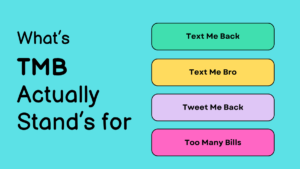
Too Many Bills |
Venting about money, relatable memes |
Rare |
Unless the sentence clearly points somewhere else — like a joke about rent and phone bills — you can safely assume “Text Me Back” is what the sender means.
Every TMB Meaning Explained, With Examples 💬
Knowing the four possible meanings is one thing — actually spotting which one applies in the moment is another. Here’s each meaning of tmb meaning in text broken down with a real example, so you can tell them apart at a glance.
1. Text Me Back
This is the default meaning of tmb about 90% of the time. Someone sends it after sharing something they want a response to.
Friend: “Just sent you the details for the party.”
Friend: “Tmb when you read it.”
Here, “tmb” is doing exactly one job: reminding you to reply once you’ve seen the message. There’s no hidden tone — it’s practical and a little impatient at most.
2. Text Me Bro
Among close guy friends especially, tmb can stand in for “text me bro.” It’s more of a sign-off than a request for information.
You: “Heading out, catch you later.”
Friend: “Alright, tmb when you’re home.”
This version feels warm and casual. It’s less “reply to my last message” and more “keep in touch.” You’ll mostly see it in tight friend groups or gaming chats where everyone already talks this way.
3. Tweet Me Back
On X (formerly Twitter), tmb occasionally shrinks down from “tweet me back.” It shows up when someone wants a reply to a tweet or a mention rather than a text message.
User: “Just tagged you in my thread 👀”
User: “Tmb when you get a sec.”
This meaning depends heavily on platform. If the conversation is happening on X and there’s no texting context at all, “tweet me back” is usually the safer read.
4. Too Many Bills
This one is the rarest by far, and it almost never appears without obvious context clues — usually money, rent, or adulting struggles.
You: “How’s this month treating you?”
Friend: “Honestly, tmb. Rent just hit.”
If “tmb” shows up in a sentence about finances, subscriptions, or bills, it’s almost certainly “too many bills” rather than a request to text back. Context really is everything here.
How People Use TMB Across Different Apps 📲
Friends and Group Chats 👥
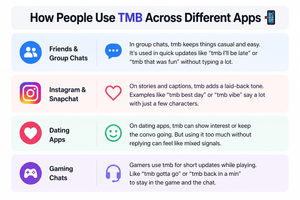
Among friends, tmb is about as casual as it gets. Someone might send “just dropped the address for tonight, tmb when you’re free” and move on with their day. Nobody reads much into it — it’s just a soft reminder to circle back.
Instagram and Snapchat 📸
On visual platforms, people fire off short captions and expect equally short replies. “Sent you the photos, tmb what you think” is a typical example. It’s less about urgency and more about keeping the back-and-forth moving without typing paragraphs.
Dating Apps 💕
This is where tone starts to matter. On a dating app, “had a good time tonight, tmb tomorrow?” can feel warm and inviting. But if someone sends “tmb” over and over with no reply from you, it can start to feel like pressure rather than genuine interest. One text is a nudge; five in a row is a red flag.
Gaming Chats 🎮
Gamers already speak in shorthand – gg, afk, brb – so tmb fits right in. You’ll see it when someone steps away mid-session: “logging off, tmb once I’m back online.”
Work and Professional Chats
This is the one place tmb meaning in text doesn’t really belong. Coworkers and clients generally expect full sentences, so swapping “please reply when you can” for “tmb” can come across as sloppy, even if that’s not how it was meant.
TMB and Its Texting Cousins: DSL, WTV and IMK
Once you’ve got tmb figured out, a handful of similar abbreviations tend to show up in the same conversations. Here’s what they mean so you’re not left guessing next time.
|
Abbreviation |
What It Means |
Typical Use |
|
Whatever |
Shows indifference or a laid-back ‘it’s fine either way’ attitude. |
|
|
In My Knowledge |
Used when sharing something you believe is true but aren’t 100% certain of. |
|
|
A playful, complimentary slang term about someone’s lips |
Shows up mostly in flirty captions and comments — tone and emoji decide whether it’s a joke or a genuine compliment. |
WTV meaning slang is about as low-key as texting gets – someone replies “wtv” when they genuinely don’t have a strong opinion either way, or occasionally when they’re a little annoyed and don’t want to say so directly. IMK, on the other hand, is a soft way of sharing information: “imk the store closes at nine, but don’t quote me.” It signals “this is what I believe, not a guaranteed fact.” DSL is a bit more playful and appearance-related, so it’s best kept to casual, friendly conversations rather than anything formal.
Is TMB Rude, Flirty, or Totally Neutral? 🤔
On its own, tmb carries no attitude at all — it’s just a request. The feeling behind it comes entirely from the surrounding conversation.
- Friendly: “Sent the notes from class, tmb when you get a chance.”
- Neutral: “Emailed the file over, tmb.”
- Flirty: “Had fun tonight, tmb in the morning 😊.”
- Pushy: “tmb” sent three times in a row with no context.
If you’re ever unsure how someone meant it, look at how often they’re sending it and what came right before. A single, casual “tmb” almost never means anything negative.
How to Reply When Someone Texts You TMB 💬
You don’t need a clever comeback – a short, natural reply does the job. Something like “just saw this, give me a sec” or “got it, replying now” keeps the conversation moving. With close friends, a lighthearted “okay okay, I’m typing!” works just as well. In a work setting, skip the abbreviation entirely and write “thanks for the reminder, I’ll respond shortly” instead.
Similar Texting Terms Worth Knowing 📚
Once you understand tmb meaning in text, a few related abbreviations become much easier to decode too:
- brb – be right back
- hmu – hit me up (get in touch)
- lmk – let me know
- wyd – what are you doing
- ikr – I know, right
- tbh – to be honest
Most of these follow the same logic tmb does: they save typing time without losing the meaning behind the message.
If you’re curious about where this kind of shorthand comes from historically, Merriam-Webster’s overview of abbreviations is a solid, no-nonsense place to start.
When You Should Skip Using TMB 🚫
A few situations call for spelling things out instead of leaning on slang:
- Professional emails or work messages, where clarity matters more than speed
- Conversations with someone from a different generation or country who may not know internet shorthand
- Serious or emotional conversations, where a full sentence feels more genuine
- School assignments or anything formally written
Final Thoughts 📝
Texting language moves fast, and it’s easy to feel a step behind when a new abbreviation pops up out of nowhere. But once you understand tmb meaning in text, the mystery disappears — it’s simply a low-key way of asking for a reply, nothing more dramatic than that. Pay attention to who’s sending it and how often, and you’ll never second-guess a short text again.
Frequently Asked Questions
What does tmb meaning in text messages?
It almost always means “text me back” — a quick way of asking someone to reply once they’ve read your message.
Can tmb mean anything besides text me back?
Occasionally. Among close friends it can mean “text me bro,” and on X it sometimes means “tweet me back,” though these are far less common.
Is it okay to use tmb with someone I just started talking to?
Yes, in casual settings like social media or dating apps. Just avoid sending it repeatedly — one nudge is enough.
Should I use tmb at work?
It’s better to avoid it. Stick with “please reply when you have a moment” for anything professional.
