
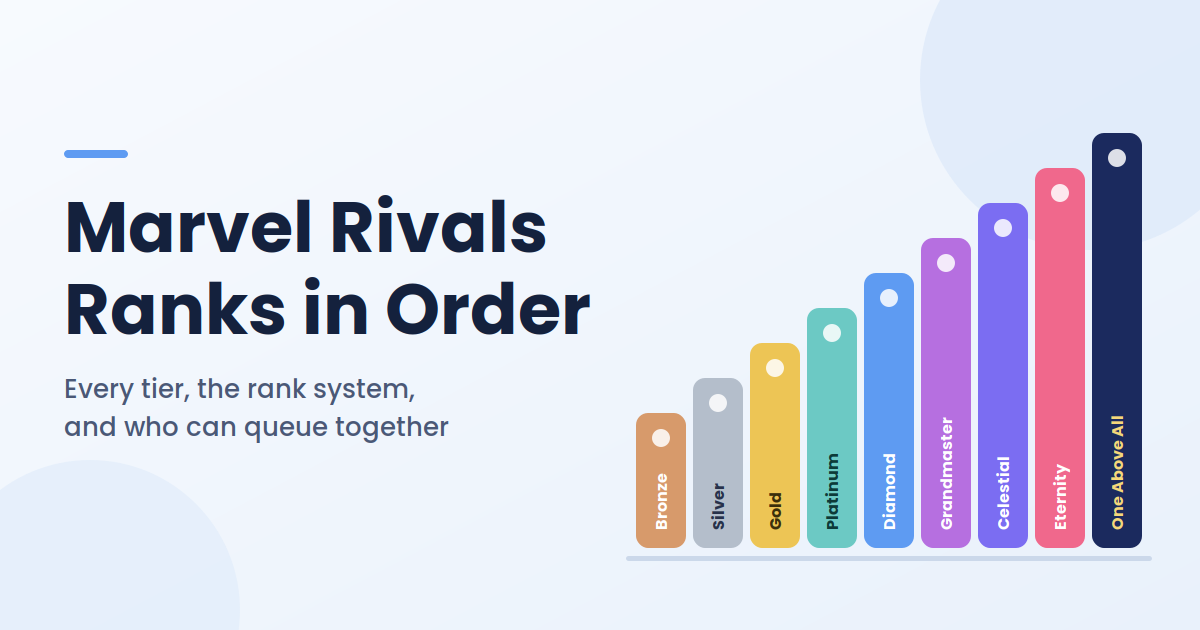

Marvel Rivals ranks decide who you play against, how fast you climb, and which skins you get at season’s end. So what are the Marvel Rivals ranks? There are nine of them, starting at Bronze and finishing at One Above All.
Most ranks are split into three tiers. This guide walks through the full ladder, how points move, where players actually sit, and who you can party up with.
What Are the Ranks in Marvel Rivals? All Marvel Rivals Ranks in Order
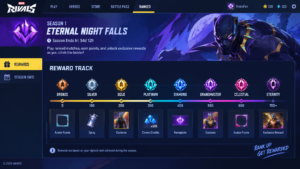
Here are all Marvel Rivals ranks in order, lowest to highest. Bronze through Celestial each have three tiers (III, II and I), and Tier I is the highest one before you move up.
| # | Rank | Tiers | What it feels like |
| 1 | Bronze | III, II, I | Learning heroes, maps and objectives |
| 2 | Silver | III, II, I | Basic teamwork starts to show up |
| 3 | Gold | III, II, I | Better positioning and timing |
| 4 | Platinum | III, II, I | Mistakes cost more, comps matter |
| 5 | Diamond | III, II, I | Strong aim, coordinated pushes |
| 6 | Grandmaster | III, II, I | Sharp calls, very few free wins |
| 7 | Celestial | III, II, I | Last tiered rank, high-level play |
| 8 | Eternity | Points only | No tiers, pure rank points |
| 9 | One Above All | Points only | Reserved for the top 500 players |
What Are All the Ranks in Marvel Rivals? The Short Version
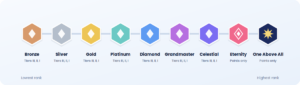
If you want the quick answer, it’s Bronze, Silver, Gold, Platinum, Diamond, Grandmaster, Celestial, Eternity and One Above All. Everything up to Celestial is tiered.
Eternity and One Above All work differently, so we’ll get to them in a second.
Marvel Rivals Competitive Ranks: Low, Mid and High
It helps to think of the Marvel Rivals competitive ranks in three bands. Bronze to Gold is where you learn the basics and fix bad habits.
Platinum to Grandmaster is where team composition and hero pool start to matter. Celestial and above is where coordination, ult tracking and consistency decide almost every match.
Pull quote: “A rank badge shows how you play on your average night, not on your best one.”
Marvel Rivals Rank System: How Points, Tiers and Divisions Work
The Marvel Rivals rank system is based on points. You earn rank points when you win a match. You lose, you lose some.
Guides tend to suggest a full rank takes about 300 points, each tier takes about 100. So take that as a rule of thumb , as the game doesn’t disclose a precise formula ( verify ) .
How Your Marvel Rival Rank Moves
Your wonder rival rank is not just a reactive measure of victories and defeats. The backdrop of the match also important, so beating a stronger lobby usually pays better than stomping a weaker one.
Streaks can impact your movement speed. A hot streak will speed you up and a cold one will bring you down faster than you think.
- Wins add points, losses remove them.
- Gains tend to be bigger at lower ranks, so early climbing feels quick.
- Leaving matches or disconnecting can lead to heavier penalties.
- Going inactive at the very top can cost you points over time.
Chrono Shield and Demotion Protection
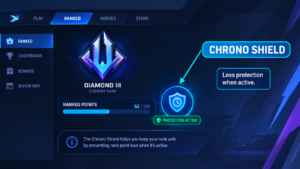
The Chrono Shield is a safety net that protects you from losing points after a defeat. Think of it as a “free loss” that recharges as you play.
Sources describe the recharge a little differently, so check the in-game tooltip for your current season (verify). Some ranks also give you a small buffer before you actually get demoted.
Hero Bans in Ranked
Once you reach the mid-to-high ranks, each team can ban heroes before the match starts. Guides put the starting point somewhere between Gold III and Diamond, so confirm the current rule (verify).
Bans punish one-tricks hard. If you’re aiming for Platinum or Diamond, start building a second and third pick now.
Marvel Rivals Rank Distribution: Where Do Most Players Sit?
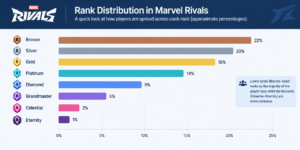
NetEase doesn’t publish an official breakdown, so we rely on tracker data. The numbers below come from RivalsTracker’s sample of about 975,000 PC players in July 2026, as reported by BuyBoosting.
Trackers lean toward active players, so the real population is probably a bit more bottom-heavy.
| Rank | Share of players | Roughly top… |
| Bronze | 25.8% | Everyone |
| Silver | 9.7% | Top 74% |
| Gold | 12.3% | Top 65% |
| Platinum | 13.6% | Top 52% |
| Diamond | 15.5% | Top 39% |
| Grandmaster | 15.1% | Top 23% |
| Celestial | 6.5% | Top 8% |
| Eternity | 1.4% | Top 1.5% |
| One Above All | 0.1% | Top 500 |
Marvel Rival Ranks vs Real Skill
Platinum is basically the middle of the ladder. Diamond is above average, even though the community sometimes treats it as “mid.”
Grandmaster is a top-quarter rank. So if you’re sitting there, you’re doing better than you probably feel after a bad night.
What Ranks Can Play Together in Marvel Rivals?
Party rules are loose at the bottom and tighter as you climb. This is one of the most common questions, so here’s the plain version.
- Gold and below: you can usually queue with friends without a big restriction.
- Gold I to Celestial: you generally need to be within three divisions of each other.
- Eternity and One Above All: grouping is limited, with a points window and smaller party sizes.
These limits come from community guides, and they can change between seasons, so check the party screen before you invite someone (verify).
Marvel Rivals What Ranks Can Play Together: Quick Examples
If you’re Gold III and your friend is Platinum III, that usually works. If you’re Platinum II and they’re Diamond III, you may be too far apart.
Playing with a higher-ranked friend can also drop you into tougher lobbies. Fun, yes, but your points may swing harder.
How to Unlock Ranked and What Rewards You Get
You unlock competitive at account level 10, according to most guides. One source mentions level 15 for some seasons, so confirm on the Competitive tile (verify).
Play Quick Play first if you’re still leveling. It’s the easiest way to learn maps and heroes without any pressure.
- Season rewards depend on the highest rank you reach, so a late drop doesn’t remove them.
- You can expect an exclusive skin starting around Gold.
- Higher ranks add Crests of Honor for Grandmaster, Celestial and the top end.
- Rewards change every season, so always read the current season page before listing them.
How to Climb the Marvel Rivals Ranks Without Burning Out
Climbing is mostly about habits, not tricks. These five things help at every rank.
- Main one hero per role first. Depth beats variety while you’re learning.
- Talk to your team. Call ult timers, flanks and objective status.
- Stop after a bad run. Three losses in a row usually means tilt, not bad luck.
- Queue with someone close to your rank. It keeps lobbies fair and fun.
- Fix your setup. A steady frame rate, low latency and a comfortable mouse help every single match.
Pull quote: “Rank climbing is a boring habit game. The people who improve are the ones who review one match a day.”
On the hardware side, a 144Hz display and a reliable mouse make aim feel noticeably smoother. See our guides on the best gaming monitors and the best gaming mouse for FPS.
Ranked Chat Slang: WSG Meaning in Text, TMB Meaning in Text and Yh Meaning in Text
If you play with randoms or join Discord parties, you’ll see short slang in the chat. Here are three you’ll run into.
- WSG meaning in text: short for “what’s good,” a casual hello. Example: “wsg, anyone down for ranked?”
- TMB meaning in text: most often “text me back.” Example: “tmb when you’re online.”
- Yh meaning in text: a quick spelling of “yeah.” Example: “yh I can play support.”
Meanings can shift between communities, so read the context before you reply.
Final Thoughts on Marvel Rivals Ranks
Marvel Rivals ranks are easy once you see the whole ladder: nine ranks, three tiers up to Celestial, and a points-only top end. Know the rank system, check the distribution, and queue with the right people.
Want to pick better heroes for your climb? Read our Marvel Rivals tier list next.
