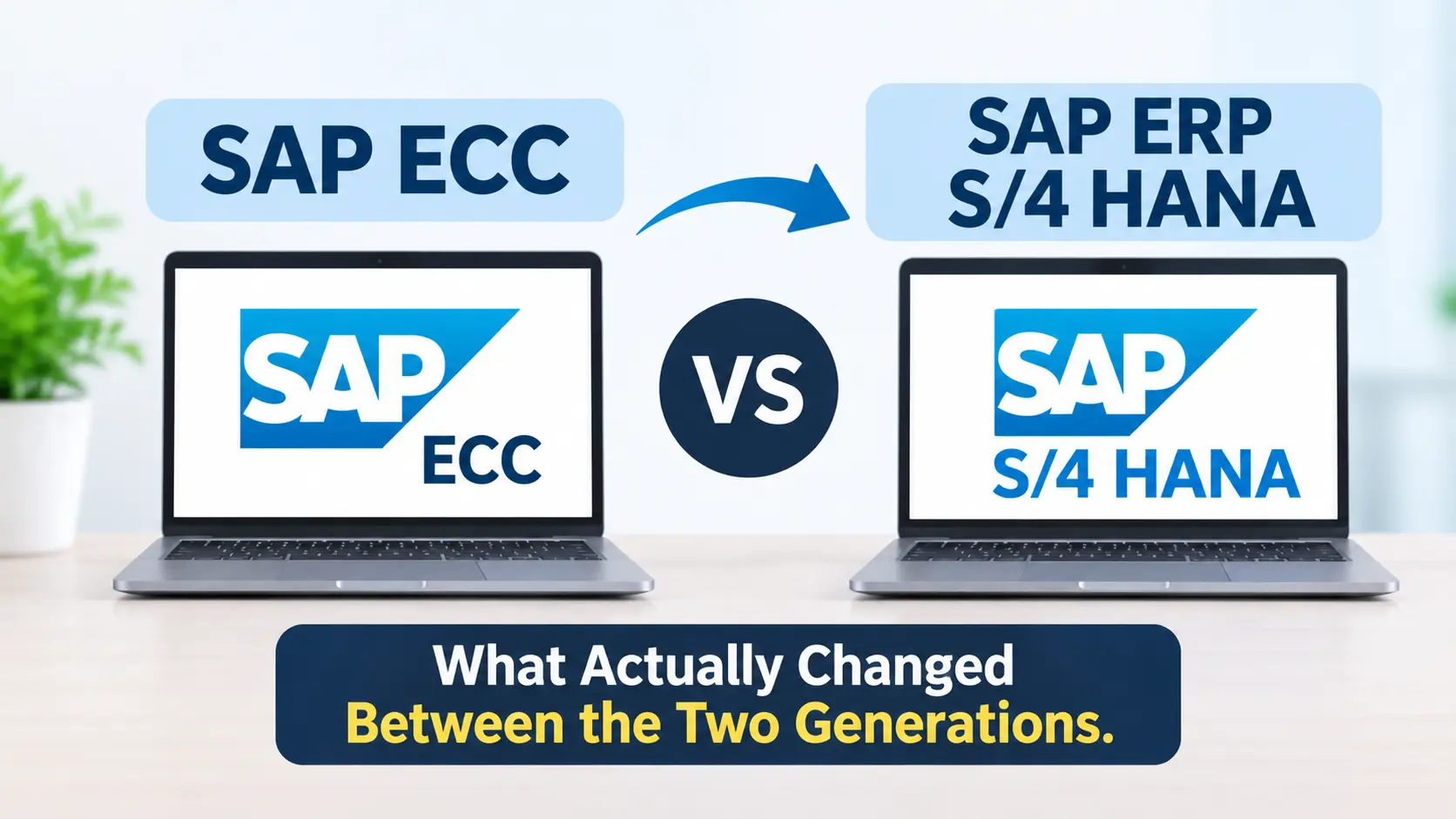

Open almost any SAP job post and you’ll see two names side by side: ECC and S/4HANA. They sound like cousins. In a way they are, but they were built in different eras on very different foundations.
This guide explains SAP ECC in plain language, compares it with SAP ERP S/4 HANA, and untangles the confusing phrase “SAP ERP HANA.” No consultant jargon, just the differences that matter.
Quick answer: SAP ECC is the older ERP system. S/4HANA is the newer one, built only on the HANA database. SAP’s mainstream support for ECC is scheduled to end in 2027.
What Is SAP ECC? Full Form, Purpose, and Where It Still Runs
SAP ECC stands for ERP Central Component. It is the core of the SAP ERP suite, the software that ties a company’s finance, sales, buying, and production into one system.
When people say SAP ECC, they usually mean version ECC 6.0. It has run large manufacturers, retailers, and utilities for roughly twenty years.
Its main modules include:
- FI (Finance): ledgers, payables, and receivables
- CO (Controlling): cost centers and profit analysis
- SD (Sales and Distribution): orders, pricing and billing
- MM (Materials Management): purchasing and inventory
- PP (Production Planning): manufacturing schedules
- HCM (Human Capital Management): payroll and personnel
ECC is flexible, and companies have bent it heavily to fit their own processes. That flexibility is also why leaving it takes so long.
ECC is like a well-worn workshop. Every tool sits where the owner left it, which is both its charm and its problem.
SAP ECC vs. SAP ERP: Same Name in Casual Talk, Different Layers on Paper
People often use “SAP ERP” and “SAP ECC” as if they were one thing. They overlap, but they aren’t identical, and the difference matters when you read documentation.
SAP ERP is the product line. ECC is the central component inside it, the part that actually runs business processes.
- SAP ERP: the overall product family
- SAP ECC: the core application inside that family
- SAP S/4HANA: the next-generation ERP built to succeed it
In everyday conversation, treating the first two as synonyms is fine. In a project plan or a contract, be precise.
|
Generation |
Era |
What defined it |
|
SAP R/3 |
Early 1990s |
Client-server design that moved SAP beyond mainframes |
|
SAP ECC |
From 2004 |
Web-enabled core, widely customized, and many database options |
|
SAP S/4HANA |
From 2015 |
Rebuilt for the HANA in-memory database |
SAP ERP HANA Explained: Why the Database Name Causes So Much Confusion
HANA is SAP’s in-memory database. It keeps working data in fast memory instead of fetching it from disk every time, which is why reports run so much quicker.
“SAP ERP HANA” is a loose phrase people use for two different things. Sometimes they mean ECC running on a HANA database. Other times they mean S/4HANA.
- HANA: the database layer
- ECC on HANA: the old application on the new database
- S/4HANA: a new application that runs only on HANA
Moving ECC onto HANA swaps the engine only. S/4HANA swaps the engine and rebuilds much of the car around it.
SAP ECC vs. SAP ERP S/4 HANA: Side-by-Side Comparison
Here is how the two systems differ in the areas that matter most day to day.
|
Area |
SAP ECC |
SAP S/4HANA |
|
Database |
Several options, including Oracle, DB2, SQL Server, and HANA |
HANA only |
|
User interface |
SAP GUI, the classic screens |
SAP Fiori, browser-based and role-focused |
|
Finance data |
Separate accounting and controlling records; classic or new general ledger |
Single Universal Journal: new general ledger only |
|
Customers and vendors |
Separate master records |
Merged into Business Partner |
|
Reporting |
Often needs a separate reporting system |
Analytics built into the core |
|
Deployment |
Mostly on-premise |
On-premise, private cloud or public cloud |
|
Vendor support |
Mainstream support ends 2027 |
SAP has committed to maintain S/4HANA through 2040 |
No single row is dramatic by itself. Together they explain why moving to S/4HANA is a bigger change than a normal upgrade.
Why SAP ECC Is Still Everywhere, and Why That Matters for Tech Careers
Large ERP projects are slow, expensive, and risky. A system that works, even an aging one, is hard to justify replacing on a busy company’s timeline.
That leaves a long tail of ECC systems that need people who understand them, and a growing wave of migration work. Both sides of the move create jobs.
- Support roles: keeping ECC stable while the migration is planned
- Migration roles: mapping old processes and custom code to the new system
- Analytics and AI roles: using clean S/4HANA data once the move is done
For learners, this means ECC knowledge isn’t wasted. It becomes the starting point for understanding what changed.
What’s Actually New Inside S/4HANA
S/4HANA isn’t just ECC on a faster database. A few design choices change how people work.
- Universal Journal: Finance postings live in one place, so accounting and controlling no longer need constant reconciling.
- Business Partner: One record can describe a company that is both a customer and a supplier.
- Fiori screens: simpler pages that work in a browser and on tablets.
- Embedded analytics: live reports without exporting data elsewhere.
- Clean core approach: keep custom code outside standard SAP so future updates hurt less.
The biggest shift isn’t speed. It’s the idea that custom code should sit beside the core, not inside it.
SAP ECC Support Timeline: The Dates Everyone Is Watching
The deadline is the main reason this comparison keeps trending. SAP’s published plan separates support into stages instead of one hard stop.
|
Stage |
Dates |
What it means |
|
Mainstream maintenance |
Through Dec 31, 2027 |
Standard support for the core Business Suite 7 applications, including ECC. |
|
Extended maintenance |
2028 to 2030 |
Optional and paid; reported at roughly a 9% premium on standard fees. |
|
Transition option |
Up to 2033 |
SAP describes this for customers who move to SAP ERP, private edition. |
|
Afterwards |
Beyond the above |
Customer-specific maintenance, with less vendor coverage. |
ECC doesn’t switch off on January 1, 2028. The risk grows quietly: fewer fixes from SAP and more responsibility for the customer.
Analyst firm Gartner has estimated that around four in ten ECC customers will still use it in key business areas by 2030. Plenty of companies will miss the first date.
Dates and fees can change, so confirm them on SAP’s official site before you act.
Should a company move from SAP ECC to S/4HANA now, or wait?
There is no single right answer. The deadline creates pressure, but it shouldn’t be the only reason to decide.
- Migrate now: best when the business case is clear and the team has capacity.
- Buy time with extended maintenance: useful when the project needs more planning, at an extra cost.
- Use third-party support: an option some firms choose, though it brings its own trade-offs.
- Re-check the fit: a few organizations question whether S/4HANA suits their industry at all.
If you do migrate, there are two common routes. Which one fits depends on how much of your current setup you want to keep.
- System conversion: move the existing system and its data to S/4HANA, keeping much of your history and processes.
- New implementation: start fresh on S/4HANA, redesign processes, and bring over only the data you need.
Whichever path you pick, start with an inventory of your custom code. It is usually the biggest hidden cost.
Where AI Fits Into the SAP ECC Story
SAP is building its newer AI features around S/4HANA and its cloud services, not around ECC. That gives migration a second motive beyond support dates.
- Cleaner data: a single finance record gives AI tools less to untangle.
- Faster analytics: in-memory processing suits real-time forecasting.
- Less custom clutter: a clean core makes it easier to plug in new services.
Product names change fast, so check SAP’s current documentation before you plan around a specific feature.
Common Mistakes When Comparing SAP ECC and S/4HANA
- Treating “SAP ERP HANA” as a single product.
- Assuming ECC will stop working the day mainstream support ends.
- Judging the two systems by the screen design alone.
- Skipping the data-model changes, especially in finance.
- Leaving custom code out of the migration estimate.
FAQs: SAP ECC, SAP ERP, and S/4HANA
What does ECC stand for in SAP?
ECC stands for ERP Central Component. Some blogs write “Enterprise Central Component,” but ERP Central Component is the standard form.
Is SAP ECC the same as SAP ERP?
Not exactly. SAP ERP is the product line, and ECC is its core component, though many people use the terms interchangeably.
When does SAP ECC support end?
Mainstream maintenance is scheduled to end on December 31, 2027. Optional extended maintenance runs through 2030.
Does S/4HANA replace ECC?
Yes, SAP positions S/4HANA as the successor. Existing ECC customers must plan a move, and the timing is their choice.
Can SAP ECC run on HANA?
Yes. ECC can run on a HANA database, but that only changes the database. It does not turn ECC into S/4HANA.
Final Words: Pick the Path, Not Just the Product
SAP ECC is the proven older system. SAP ERP S/4 HANA is the rebuilt successor, and the real differences sit in the data model, the interface, and the support timeline.
Whether you are choosing what to learn or what to run, start with the dates and your own custom code. The rest follows from there.
