

Key Takeaways
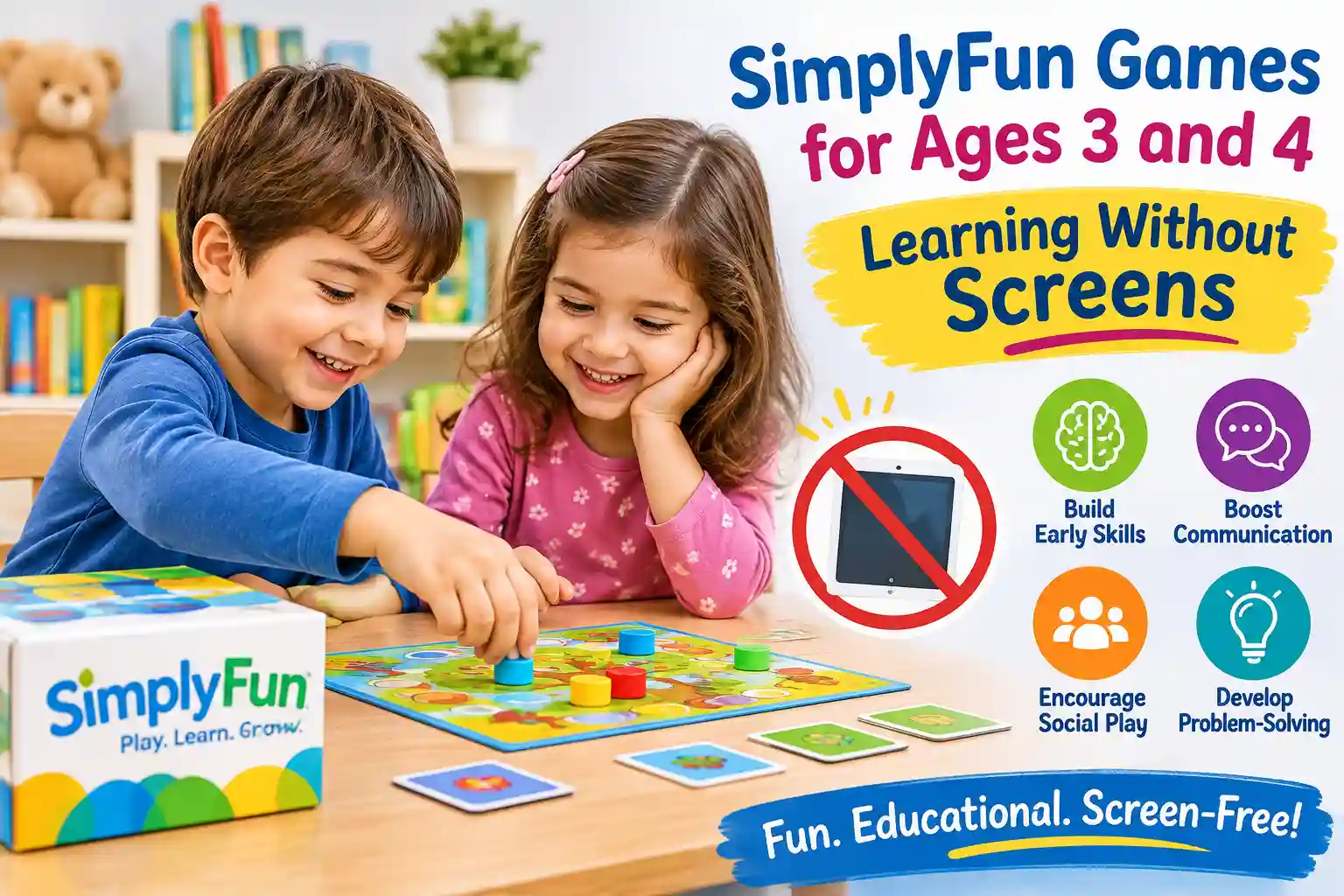
- SimplyFun games for ages 3 and 4 offer hands-on opportunities to practice early learning skills through play.
- Different games encourage counting, letter recognition, vocabulary, memory, shapes, coordination, and storytelling.
- Turn-taking and cooperative activities help preschoolers practice communication, patience, and social interaction.
- Choose games based on a child’s interests, developmental stage, attention span, and learning needs.
- Short, flexible play sessions can make learning enjoyable without turning activities into formal lessons.
- Hands-on games can complement books, outdoor activities, imaginative play, and balanced screen-time routines.
- Parents and educators can make play more meaningful by asking questions, modeling skills, and encouraging effort rather than focusing only on winning.
For parents and educators, finding activities that feel fun while still supporting early learning can be a daily challenge. Preschoolers need opportunities to talk, move, create, solve small problems, and practice playing with others. SimplyFun games for ages 3 and 4 offer a hands-on way to add short, structured play sessions to a routine without turning every moment into formal instruction. These games are not a replacement for books, outdoor time, imaginative free play, or meaningful caregiver interaction. Instead, they can give children another way to explore early counting, language, memory, coordination, communication, and turn-taking through repeatable play. The SimplyFun preschool collection includes games with suggested playtimes ranging from about 10 to 30 minutes, which can be a manageable format for many young children.
Why Does SimplyFun Focus on Ages 3 and 4?
Ages 3 and 4 are full of rapid change. Children are building vocabulary, noticing letters and numbers, learning to follow simple directions, developing coordination, and beginning to understand how their actions affect other people. They are also learning that games involve rules, waiting, wins, losses, and flexible thinking.
Rather than presenting preschool play as one-size-fits-all, SimplyFun organizes games around different interests and learning focuses. Families can explore options that emphasize:
- Math and STEM: Counting, colors, shapes, matching, and early number recognition.
- Reading and language: Letters, vocabulary, storytelling, and alphabet sequencing.
- Life and thinking skills: Memory, planning, creativity, fine motor practice, and gross motor movement.
- Social development: Communication, cooperation, sharing, and social-emotional play.
How Does Play Connect With School Readiness?
Games can create natural chances to practice skills children will use in preschool and kindergarten. Following a sequence, remembering a picture, listening for a direction, naming an emotion, and waiting for a turn are all small tasks that can become familiar through play. The federal guidance on preparing young children for school highlights intentional support for social-emotional skills, executive function, mathematics, vocabulary, letters, and sounds. A board game cannot guarantee a particular developmental outcome, but a well-matched game can provide adults and children with a positive setting to practice these skills together.
Which SimplyFun Games Match Common Preschool Needs?
Early Math and Fine Motor Practice
Uncle Beary’s Bedtime is a counting game for ages 3 and up that uses a simple bedtime theme and a 15-minute suggested playtime. It can encourage children to count aloud and connect number words with game actions. Share a Berry, also suggested for ages 3 and up, combines early counting with fine motor activity and cooperative play.
Letters, Language, and Storytelling
Rooby’s ABCs is designed for letter recognition and alphabet sequencing, with a suggested 10-minute playtime for one to four players. Adults can extend play by asking children to name letters, point out familiar sounds, or think of words that begin with a letter. Wake Up Stars uses storytelling and social-emotional themes, giving children opportunities to describe pictures, talk about feelings, and invent what might happen next.
Memory, Shapes, and Movement
My Fun Shapes includes wooden blocks and cards for exploring colors, shapes, matching, and fine motor skills. For children ready for more active play, Buddy Hop is suggested for ages 4 and up and combines memory, sequencing, and gross motor movement. Movement-based games can be especially useful when sitting still for a longer activity is difficult.
Turn-Taking and Cooperation
Animal Snacks is a turn-taking game for ages 3 and up. It gives adults a simple setting for modeling language such as “my turn,” “your turn,” “can I help?” and “let’s try again.” Young children may still need support when they feel disappointed or impatient, and that support is part of the learning value.
How Should Families Choose a Game?
- Begin with an existing interest. Animals, stories, colors, movement, letters, and numbers can all make a game feel more inviting.
- Use the suggested age as a guide. A child’s experience, confidence, and attention span matter as much as the number on the box.
- Pick one main focus. Choose counting, language, matching, memory, communication, or movement instead of expecting one game to do everything.
- Keep the first session short. Stop while the child is still interested, even if the game is unfinished.
- Adapt when needed. Reduce the number of pieces, take turns with the child, or simplify a rule before adding new challenges.
Can Hands-On Games Support a Healthier Screen-Time Balance?
Hands-on games can be one useful choice during a planned device-free part of the day, such as after preschool or before dinner. The American Academy of Pediatrics notes that screens should not replace sleep, play, physical activity, reading, or time with caregivers, and its discussion of balanced screen use for preschoolers emphasizes both content quality and the role screens play in a family routine. The goal is not to treat all screen use as negative. It is to make room for a variety of experiences. A 10-minute game, a story, outdoor movement, a snack conversation, and quiet independent play can all have a place in a balanced day.
How Can Adults Make Game Time More Meaningful?
- Ask open questions, such as “What do you think will happen next?”
- Use descriptive language instead of correcting every mistake immediately.
- Invite the child to explain a rule in their own words.
- Connect the game to daily life by counting snacks, sorting laundry, or naming shapes around the room.
- Celebrate effort, cooperation, and persistence, not only winning.
What Makes SimplyFun Practical for Families and Educators?
The preschool collection includes filters for player count, learning categories, awards, autism considerations, and special-needs considerations. Some games support solo play, while others are designed for two or more players. SimplyFun also states that its products meet or exceed the United States’ ASTM safety standards for toys and games, and that the company offers replacement pieces when available for lost or damaged components.
How Can Families Build a Weekly Play Routine?
- Monday: Play a counting or matching game.
- Tuesday: Choose letters, vocabulary, or storytelling.
- Wednesday: Try memory or shape-based play.
- Thursday: Add a movement-focused game.
- Friday: Choose a cooperative or imaginative activity.
This plan is flexible. Repeating a favorite game is valuable because familiarity can help children feel confident enough to try a new skill, explain a rule, or take a more independent role.
Frequently Asked Questions
Are SimplyFun games for ages 3 and 4 educational?
They are designed around skills such as counting, letters, colors, shapes, memory, communication, storytelling, and motor development. They are best viewed as playful learning tools, not formal assessments or guaranteed academic programs.
What is the best game for a three-year-old?
The best choice depends on the child. Games involving simple matching, counting, colors, shapes, stories, or turn-taking are often approachable starting points for children ages 3 and up.
What is the best game for a four-year-old?
Many four-year-olds may enjoy a greater challenge involving sequencing, memory, alphabet play, movement, or cooperative rules. Check each game’s suggested age, player count, and playtime before choosing.
Why Choose SimplyFun for Preschool Play?
SimplyFun gives families and educators a structured way to turn brief play sessions into opportunities for conversation, counting, movement, imagination, and cooperation. When used alongside books, outdoor activity, free play, and caregiver connection, these games can be a useful part of a varied preschool routine.
Conclusion
Finding engaging activities for preschoolers is easier when learning feels like play rather than another lesson. SimplyFun games for ages 3 and 4 provide families and educators with hands-on options that encourage early skills such as counting, language, memory, coordination, communication, and cooperation. Choosing activities that match a child’s interests, abilities, and attention span can help make each session more enjoyable and meaningful. Adults can further support learning by asking questions, simplifying rules when needed, and allowing children to explore at their own pace. When combined with books, outdoor activities, imaginative play, and caregiver interaction, these games can become a useful part of a balanced preschool routine.
