
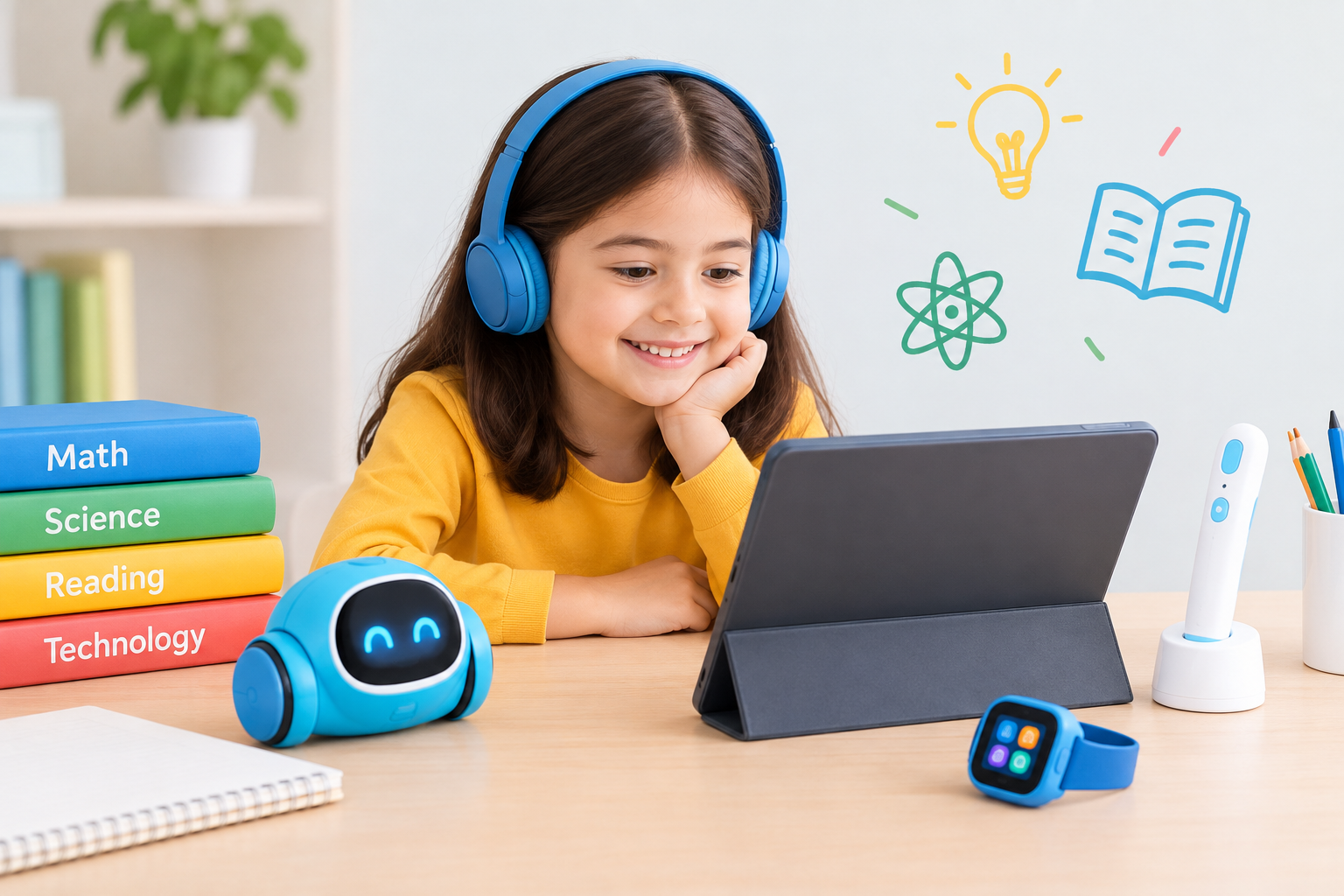

Facing shelves full of gadgets, all claiming to be “educational,” while standing in the electronics aisle ahead of your birthday may easily confuse you. Some gadgets are indeed educational as others are simply tablets decorated with cartoon stickers. However, this guide represents an attempt to understand which gadgets can be truly useful for education and what differentiates them from mere entertainment devices. It provides a list that you might consider for children of all ages. No jargon, no hype, just a look at what works and why.
What Makes a Gadget “Educational” Anyway?
The gadget can be referred to as educational if it prompts a child to take actions rather than to observe. Does it make the child think, analyze, and try to understand the reasons why the robot will not move to the left or how to read the next word? It is the sign. The device that only plays videos continuously does not mean that it is educational, despite any claims on its package.
There are several factors that will help to distinguish between an educational and noneducational gadget. First of all, does it have anything to do with a skill (reading, math, or programming logic)? Is the gadget interactive? Finally, is it made for kids of this particular age or advertised to them? All in all, the role of gadgets in education comes to the point that a good one develops skills.
Why Educational Gadgets Matter for Kids Today
Children differ greatly in terms of pace and, consequently, one of the most powerful reasons why gadgets are good for education is that they can adapt to the pace of a child rather than vice versa. A code game in which a child can play a level five times until he understands it without anyone sighing at him is something that cannot be achieved with traditional worksheets.
Many children learn best by manipulating things rather than reading the instructions for how it should be done. This is another aspect of how today’s gadgets change our education system: learning has become less based on memorizing the things and more focused on doing them. In addition to practical benefits, there is the issue of early development of digital literacy that becomes increasingly important nowadays. And here’s another reason why gadgets are valuable for education aside from their entertainment features.
All this doesn’t mean, of course, that more screen time is always better. A device packed with a proper application still requires limits, which have to be considered while exploring the devices below.
Gadgets Education For Kids toGadgets Education For Kids Consider
This isn’t a ranked top-ten list it’s a spread of tech gadgets for education across different ages and skills, so you can find something that fits your kid rather than the general market. Think of it as a starting point for the latest technology gadgets for education worth exploring in 2026, not a shopping cart to fill all at once.
Kid-Friendly Learning Tablets
These are tablets that are made for children with parental controls integrated into them and app stores that are carefully curated for educational purposes instead of open surfing. It is ideal for kids aged 3 to 10 years and are good for practicing reading skills, playing math games, and drawing games. The best thing about them is the ability to set a daily time limit directly from the tablet instead of being the parent reminding them of it.
Coding and STEM Robot Kits
Robot toys are programmable, which means that kids can program them using some simple commands. Sometimes programming is done with the help of block programming that does not involve coding but prepares children for writing code when they get older. Such toys are suitable for ages 6 to 12 and develop problem-solving skills. Making it useful for programming and short periods should be started first because patience is required with these kits.
Smart Pens and Interactive Reading Tools
Interactive Pens and E-Readers have the capability to recognize and understand texts and provide instant definitions that help young learners without having to bother adults again and again for clarification. This device is good for children between the age of 4 to 9 years. One must use this device along with paper-based books rather than e-books because page-turning is an important aspect.
Educational Smartwatches
Smartwatches for children that are not quite up to the mark for smartphones generally combine telling time and some basic security features such as location tracking as well as light educational apps or games. These devices are perfect for children ranging from 6 to 11 years old because the element of safety is as important as education for the parents of the children.
App-Connected STEM Building Kits
Some products feature a physical construction toy along with an application for creating a video game based on it. A child could construct a maze using blocks or other pieces, then control a piece through it using the application. This category is suitable for children aged 5 to 10, mixing screen time with physically constructing a product, thus not allowing kids to sit still for too much time.
Language-Learning Devices
A specialized gadget with various language learning games would teach a second language to a child via repetition and games. This option is better than downloading an application on a family tablet as it would be used more regularly.
Math and Logic Gadgets
Items such as electronic flashcards, talking calculators, and logic puzzles are examples. They tend to be simple, non-screen-based or near-screen-free, and suitable for children between the ages of 5 and 12 years. Talking calculators that allow reading out the numbers will be extremely helpful in the case of a child having difficulties in recognizing numbers.
Kid-Safe Science Exploration Tools
Children can investigate various disciplines such as biology, astronomy, and meteorology by using simple microscopes, telescopes, and even weather stations constructed specifically for their use. Now, many of these items feature digital readouts and apps allowing collecting data over some period of time. They are suitable for children 7 to 14 years old and usually are more interesting to children than most of the screen devices.
Noise-Cancelling Headphones for Focus
It’s one of those things that never fails to be forgotten and good set of headphones that have noise cancellation and volume control for kids will go a long way in helping with online classes. As well as studying on their own from home, especially if there’s a lot of noise in the environment.
How to Choose the Right Educational Gadget for Your Child
Age appropriateness should always take priority over features, as a device full of cutting-edge options won’t help a kid who needs large buttons and simple feedback.
So, here are some aspects to check prior to buying:
- Balance screen time with offline elements. A device that does not require any manual interaction is closer to video entertainment rather than to education.
- Check parental controls and data privacy. It is way more important than most people assume, particularly in the case of internet-enabled devices.
- Match the gadget to what your child already loves or struggles with. For an unenthusiastic reader, a smart pen would be more useful than a robot for coding, although the latter is cool-looking.
- Don’t assume price equals quality. An affordable device that your child will use every day is better than an expensive one collecting dust in a box.
If the child stops using the device in a week, the problem is not the child’s. It’s a sign of a gadget not fitting its actual interests.
A Word of Caution: Gadgets Should Support Learning, Not Replace It
But there is always an element of moderation required in everything; excessive unsupervised usage of the gadget will negate all those advantages. And very soon the cost will start piling up as you will need gadgets for each subject separately. The gadget is merely a tool; it cannot replace parental guidance or teacher’s explanation in real life.
So the point here is that while using the gadget, set a moderate time frame and see whether the gadgets education continues to teach you or it becomes mere background activity.
Final Words
The ideal educational gadgets for children are not necessarily the most eye-catching ones available at the store. Instead, they should be selected based on the child’s age, interest level, and attention span. Also, they have to be used within certain limits so that they don’t become yet another piece of junk in the drawers. Begin by choosing just one gadget for now based on what your child likes at the moment and see where this takes you. For additional ideas, you can visit Techfynix’s other blog pages as well.
To Get Help About Educations for Kids visit here studyunicorn.com
Frequently Asked Questions
At what age can a kid use educational gadgets?
Most gadgets are suitable from age 3 years old for the simplest and screen-restricted ones, but a good choice would be to use them from the age of 5 or 6 years old.
Educational gadgets vs. toys which are better?
Toys have their merits, while gadgets have theirs; the best way would be to combine the two and not rely on only one. Traditional toys develop imagination and motor skills that educational gadgets do not provide.
How long should a kid spend time with gadgets?
Every family and child is unique, but a general rule states that the less time spent and more concentrated it is, the better.
How many hours a day can I give my kid with the help of learning gadgets?
Again, this issue depends on many factors such as age of the child and his or her environment, but short periods of time are better than long one. Twenty to thirty minutes of work per day may be sufficient.
