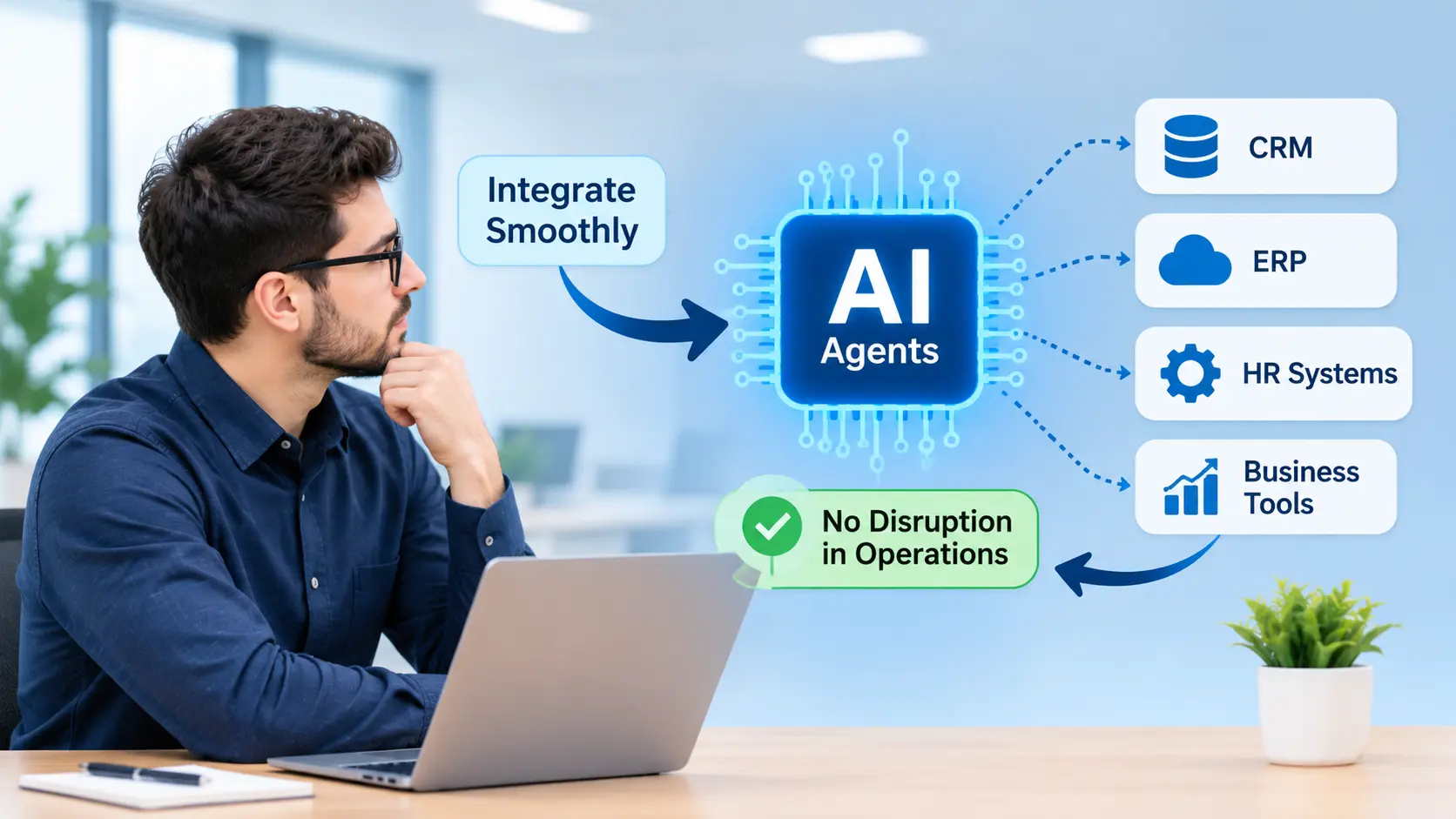

Businesses are increasingly exploring AI agents to automate repetitive tasks, improve decision-making, and reduce operational workloads. However, introducing AI into an established enterprise environment is not as simple as purchasing a new tool and connecting it to a few applications.
Most organizations already rely on a combination of enterprise resource planning (ERP) platforms, customer relationship management (CRM) systems, databases, and internal applications. These systems support critical business operations, and replacing them simply to accommodate AI is rarely practical.
The real challenge is finding a way to introduce AI agents into existing infrastructure without interrupting daily operations. This requires careful planning, reliable integrations, proper data management, and clear security controls.
Here are several important considerations for businesses looking to integrate AI agents into their existing enterprise systems.
1. Assess Existing Infrastructure Before Introducing AI
Before implementing any AI solution, businesses should understand how their current technology environment works.
Enterprise systems often contain years of accumulated data, customized workflows, and connections between different departments. An AI agent introduced without understanding these relationships could create unnecessary complications or disrupt established processes.
Start by identifying the applications that support essential business activities. This may include ERP platforms for financial and inventory management, CRM systems for customer relationships, human resources software, and internal databases.
It is also important to understand how these applications exchange information. Some systems may already communicate through APIs, while others depend on scheduled data transfers or manual processes.
This assessment helps identify potential integration challenges and opportunities for automation.
For example, a company might discover that its procurement team spends considerable time transferring purchase information between an ERP platform and a supplier management system. This could be a suitable starting point for AI-powered automation.
The goal is not to replace existing technology but to understand where AI can provide value within the current environment.
2. Build an Integration Layer Between AI and Business Systems
Once the existing infrastructure has been assessed, the next step is establishing how AI agents will communicate with business applications.
An integration layer provides a structured way for AI agents to access information and interact with existing systems. APIs are commonly used for this purpose because they allow applications to exchange data without requiring direct access to their underlying infrastructure.
For example, an AI agent responsible for processing customer requests might need to retrieve information from a CRM platform, check order details in an ERP system, and update a support ticket.
Rather than giving the agent unrestricted access to every application, developers can expose specific functions through controlled APIs.
This approach offers several advantages:
- Better access control: Applications only expose the information and functions required by the AI agent.
- Simpler maintenance: Changes to one application are less likely to affect the entire integration environment.
- Improved scalability: Additional AI agents and business applications can be connected through existing integration mechanisms.
- Reduced operational risk: Access can be monitored and restricted without modifying critical business systems.
For organizations operating legacy applications, integration may require middleware or additional connectors. This is particularly important when older systems lack modern API capabilities.
A well-designed integration layer allows businesses to introduce new AI capabilities while keeping their existing applications operational.
3. Establish a Reliable Data and Context Layer
Connecting an AI agent to enterprise applications does not automatically mean it understands the business.
AI systems need access to accurate information and sufficient context to make useful decisions. Without these elements, an agent might retrieve outdated records, misunderstand business terminology, or produce recommendations that conflict with internal policies.
Consider an AI agent handling procurement requests. It may have access to supplier records, purchase orders, and product information. However, it also needs to understand approval thresholds, preferred suppliers, purchasing policies, and other internal rules.
This is where data management and enterprise context become important.
Businesses should establish clear processes for maintaining data quality across their applications. Duplicate records, inconsistent formats, and outdated information can affect the reliability of AI-powered workflows.
They should also consider how organizational knowledge is made available to AI systems. This could involve structured databases, internal documentation, business rules, and relevant historical records.
A broader view of these components is useful when designing an enterprise AI environment. Organizations exploring the subject can learn more about AI enterprise architecture, including how integration, data, enterprise context, governance, and monitoring contribute to a connected AI ecosystem.
The objective is to give AI agents access to the information they need while maintaining consistent business rules across different systems.
4. Choose the Right AI Models and Execution Framework
Not every business task requires the same type of AI capability. Choosing an appropriate model and execution framework is therefore an important part of implementation.
Some workflows only require an AI assistant to summarize documents, classify information, or answer employee questions. Others involve AI agents that can perform multiple steps, interact with applications, and execute actions based on predefined instructions.
For example, an AI assistant might help an employee review an invoice. An AI agent, on the other hand, could extract invoice details, compare them against purchase orders, identify discrepancies, and prepare the record for approval.
The distinction matters because autonomous execution introduces additional operational considerations.
When evaluating AI models and frameworks, businesses should consider:
- Task requirements: Determine whether the workflow requires text generation, data extraction, reasoning, or multi-step execution.
- Integration compatibility: Ensure the selected solution can communicate with existing applications and infrastructure.
- Performance: Evaluate accuracy, response time, and reliability using realistic business scenarios.
- Scalability: Consider whether the solution can support additional workflows as adoption increases.
- Model flexibility: Avoid unnecessary dependence on a single provider when alternative models may offer advantages.
It is also important to define the boundaries of each agent. Not every decision should be delegated to AI, particularly when financial transactions, sensitive information, or regulatory requirements are involved.
5. Prioritize Security, Governance, and Human Oversight
AI agents can interact with multiple enterprise applications, which makes security a critical consideration.
An agent that can retrieve customer records, access financial information, or modify business documents must operate within clearly defined permissions.
Businesses should apply role-based access control to ensure that each agent only has access to the resources necessary for its assigned responsibilities.
Other important safeguards include:
- Authentication: Require secure authentication when AI agents connect to enterprise applications.
- Data protection: Apply appropriate encryption and data handling policies.
- Audit trails: Maintain records of actions performed by AI agents.
- Approval mechanisms: Require human authorization before executing sensitive operations.
- Exception handling: Establish procedures for situations the AI agent cannot resolve confidently.
Human oversight deserves particular attention.
For instance, an AI agent might be capable of identifying an invoice discrepancy and recommending a correction. However, approving a significant financial adjustment may still require an authorized employee.
This approach allows businesses to benefit from automation without removing accountability from important decisions.
Governance policies should also define who is responsible for monitoring AI systems, reviewing their performance, and responding to operational issues.
6. Monitor, Evaluate, and Improve AI Workflows
Deploying an AI agent is not the final step. Its performance needs to be monitored continuously to ensure that it remains reliable as business requirements and operational conditions change.
An agent that performs well during initial testing may encounter unexpected situations once it begins handling real business transactions.
For this reason, organizations should establish measurable performance indicators before deployment.
Useful metrics include:
- Task completion and accuracy rates.
- Average processing time.
- Number of tasks requiring human intervention.
- Frequency of failed executions.
- Operational costs associated with AI usage.
- Employee satisfaction and adoption.
Monitoring should also cover the interactions between AI agents and connected applications.
For example, if an ERP system changes its API structure, an existing AI workflow may stop functioning correctly. Regular monitoring can help identify these problems before they affect a larger number of business operations.
Employee feedback is equally valuable. People working directly with automated workflows can often identify issues that technical performance metrics do not capture.
Regular reviews allow businesses to refine instructions, improve integrations, adjust permissions, and address recurring exceptions.
7. Start Small Before Scaling Across the Enterprise
One common mistake businesses make is attempting to automate too many processes at once.
A large-scale deployment may appear attractive, but it can introduce unnecessary complexity, particularly when an organization has limited experience managing AI agents.
A more practical approach is to begin with a clearly defined workflow that has measurable outcomes.
Invoice processing, document classification, purchase order verification, and internal IT support requests are potential starting points.
For example, a company could introduce an AI agent to classify incoming invoices and extract relevant information before sending them to the appropriate department for review.
The initial implementation could focus on a single department or a limited group of users. Once the workflow demonstrates consistent results, the organization can gradually expand its capabilities.
Pilot projects should have clearly defined success criteria. These might include reducing processing time, minimizing manual data entry, or improving the accuracy of document classification.
Businesses should also document lessons learned during the pilot phase. Issues involving data quality, permissions, integration reliability, and employee adoption can inform future deployments.
This gradual approach makes it easier to identify problems, manage costs, and build confidence before introducing AI agents into more critical operations.
Conclusion
Integrating AI agents into existing enterprise systems requires more than selecting an AI model or connecting a few applications. Businesses need a structured approach that considers infrastructure, integration, data management, security, and ongoing performance.
The most effective implementations build on existing technology rather than attempting to replace everything at once. By starting with well-defined workflows, establishing clear access controls, and monitoring results, organizations can introduce AI capabilities while maintaining operational stability.
As enterprise AI adoption continues to grow, businesses that prioritize integration and sound architecture will be better positioned to scale automation across departments without creating unnecessary disruption.
