

Search for UFLI resources, and you will find hundreds of results. Slide decks, printables, books, cards, trays, and bundles all claim a spot in your phonics block. Most classrooms only need a handful of them.
This guide sorts every option into three piles: free, worth buying, and safe to skip. It is written for teachers, reading specialists and parents in the USA, Canada, Ireland, Australia and beyond. Many teachers are also studying for a degree or certificate, and an assignment writing service can be a useful source of study help and sample answers while you balance coursework with your classroom.
Buy for the problem you have today, not the one a catalog says you might have.
Key takeaways
- The official toolbox covers most daily needs at no cost.
- The teacher’s manual is the one purchase most teachers should make.
- Books and extras only help when they match the lesson order.
What Are UFLI Resources and How Does UFLI Foundations Work?
UFLI is known as the University of Florida Literacy Institute. Its Foundations program is an explicit, systematic phonics program built on a fixed scope and sequence. Every lesson follows the same routine, so students always know what comes next.
When people say ufli resources, they usually mean one of three things:
- Official: materials published by UFLI, such as the manual and toolbox.
- Aligned: materials from other publishers that follow the same ufli scope and sequence.
- Inspired: classroom ideas that borrow the style but are not checked against the sequence.
The word aligned is a seller’s claim. Compare any product against the lesson order before you buy it.
Free UFLI Resources: What the Official Toolbox Gives You
The ufli foundations toolbox is the page most teachers open every morning. Bookmark it before you spend a cent. It holds almost everything needed to teach a lesson.
Think of the toolbox as your daily workbench. The manual explains the routine, and the toolbox supplies the materials that go with it.
UFLI Lesson Resources and UFLI Digital Resources
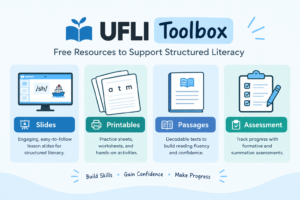
Each lesson has a matching slide deck. These ufli lesson resources guide the warm-up, the new concept and the practice. They are also the main ufli digital resources, and a cheap Bluetooth clicker lets you teach from anywhere in the room.
Some teachers find the online blending board clumsy. A blank slide with large text does the same job with no extra prep.
UFLI Printable Resources
Printable materials include letter tray mats and student practice pages. These ufli printable resources save planning time, but print only what you will use this week. A stack of unused paper helps nobody.
Print decodable stories at a slightly smaller size. Students can then trim them and glue them into a notebook for later reading.
UFLI Decodable Passages and the Placement Test
Every lesson comes with a short decodable passage that uses only skills already taught. The free placement test helps intervention teachers find the right starting lesson for a student.
| Free resource | What it does | Best for |
| Slide decks | Guide each lesson step by step | Whole-class teaching |
| Printable mats and pages | Support hands-on practice | Centers and small groups |
| Decodable passages | Practice taught skills in text | Daily fluency work |
| Placement test | Finds where a student should begin | Intervention |
| Australian toolbox | Companion materials for Australian schools | Teachers in Australia |
Paid UFLI Resources Worth Buying
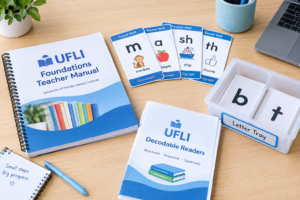
Most ufli free resources need one paid partner: the teacher’s manual. Ventris Learning, the publishing partner, lists it at about $70. It is a 376-page spiral-bound book, and the slide decks make far more sense with it open.
Printed sound wall cards are the second option. The $50 set holds 49 sound wall cards, 13 category cards, 2 label cards and 117 small grapheme cards. Teachers who prefer to print and cut can skip it.
Magnetic letters and metal trays are not official products, yet many classrooms rely on them. They make the hands-on part of each lesson quick to run.
| Item | Approx. price | Verdict |
| Teacher’s manual | About $70 | Buy it |
| Printed sound wall card set | About $50 | Nice to have |
| Magnetic letters and metal trays | Varies | Buy for hands-on lessons |
| Aligned decodable book sets | Varies | Optional, check alignment |
Prices checked in October 2026. Confirm with the seller before ordering.
UFLI Decodable Resources: How to Check Alignment
Decodable books let students use a new skill straight away. Publishers such as Little Lions Literacy and Whole Phonics sell sets matched to UFLI lessons. SPELD SA also offers a guide showing which of its books fit which lessons.
Before you buy any set, run through this checklist:
- Does the book order follow the ufli scope and sequence?
- Does it use only sounds and words students have already learned?
- Is there a guide that says when to introduce each title?
- Can you preview a sample page first?
A good set should feel like practice, not a new challenge. If students stumble often, the match is probably off.
Low-Cost Add-Ons That Make UFLI Lessons Run Smoother
Some of the best ufli resources cost almost nothing. Teachers who use the program daily keep sharing the same small tricks.
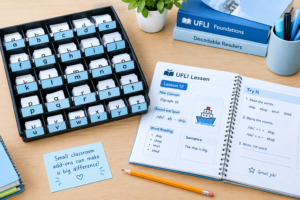
- Numbered trays: give each student a number so handing out and returning trays is quick.
- Spare letters: buy extra magnetic letters, because a few always go missing.
- Notebooks: keep each day’s writing in one place for easy review.
- Anchor charts: make one per sound and add new words as you learn them.
- Quick games: try a one-minute word reading race when the routine feels flat.
On busy days, shorten a section instead of dropping the whole lesson.
How to Use UFLI Resources Without Overloading Your Day
More materials do not mean better lessons. A calm routine beats a crowded table.
- Open the manual and slide deck for that lesson only.
- Teach in order and do not jump around the scope and sequence.
- Add one extra activity, not five.
- Use quick checks to decide whether to move on or review.
- Finish with a decodable passage or book so students apply the skill.
Fidelity matters, but so does judgment. Watch your students and adjust the pace when they need it.
Which UFLI Resources Fit Your Grade and Situation?
Kindergarten and 1st Grade
This is the unique program’s home field. Start with the guidebook and toolkit. Use decodable books after pupils learn a few sounds. Cut the fat.
UFLI 2nd Grade Scope and Sequence: What Helps Most
What Helps Most Teachers talk about the ufli 2nd grade scope and sequence as fast, with two lessons a week and a review and assessment day on the fifth. A third day can be needed for vowel teams and other complex patterns. Anchor charts and visual review cards are a huge help here.
Older Students and Intervention
UFLI was designed as a K-2 core program, yet many teachers use it for older readers. Pennington Publishing reports that UFLI director Dr. Holly Lane said:
“If they don’t know it, they need what UFLI provides.”
The catch is that passages and characters can feel young for older students, and phonics alone does not build comprehension. Pair UFLI with age-appropriate decodables and comprehension work.
Parents and Homeschool Families
Parents can use free ufli resources at home even if the school does not. Ask the teacher which lesson the class is on, then print the matching practice. A few decodable books add steady confidence.
Readers Outside the USA
Australian teachers have a dedicated toolbox version, and SPELD SA supports it with training and a decodable text guide. Readers in Canada and Ireland can use the main toolbox and adapt examples for local spelling and vocabulary.
| Reader | Start with | Add later |
| K-1 teacher | Manual, toolbox | Decodable books |
| 2nd grade teacher | Manual, slide decks | Anchor charts, picture cards |
| Intervention teacher | Placement test, toolbox | Age-appropriate decodables |
| Parent | Free printables | A few aligned books |
Choosing UFLI Resources: Mistakes That Break the Scope and Sequence
Even careful teachers fall into these traps:
- Teaching from slides alone and skipping the manual.
- Trusting the word aligned without checking the lesson order.
- Printing a whole year of materials in September.
- Adding so many extras that lessons run far past their time.
- Using beginner materials with older students without changing the tone.
A Simple UFLI Starter Kit for Any Budget
You do not need everything on day one. Build the kit over a term and add only what solves a real problem.
| Budget | What to get |
| $0 | Toolbox, slide decks, printables, placement test, plain notebook |
| About $100 | Add the manual, trays with letters and a clicker |
| Full classroom set | Add sound wall cards, decodable sets and anchor chart paper |
Final Thoughts on UFLI Resources
The best ufli resources are the ones you will actually use. Start with the free toolbox, add the manual, then buy only what fixes a real gap in your room.
Check back each August for updates, and follow techfynix.com latest blog for more practical teaching resource guides.
