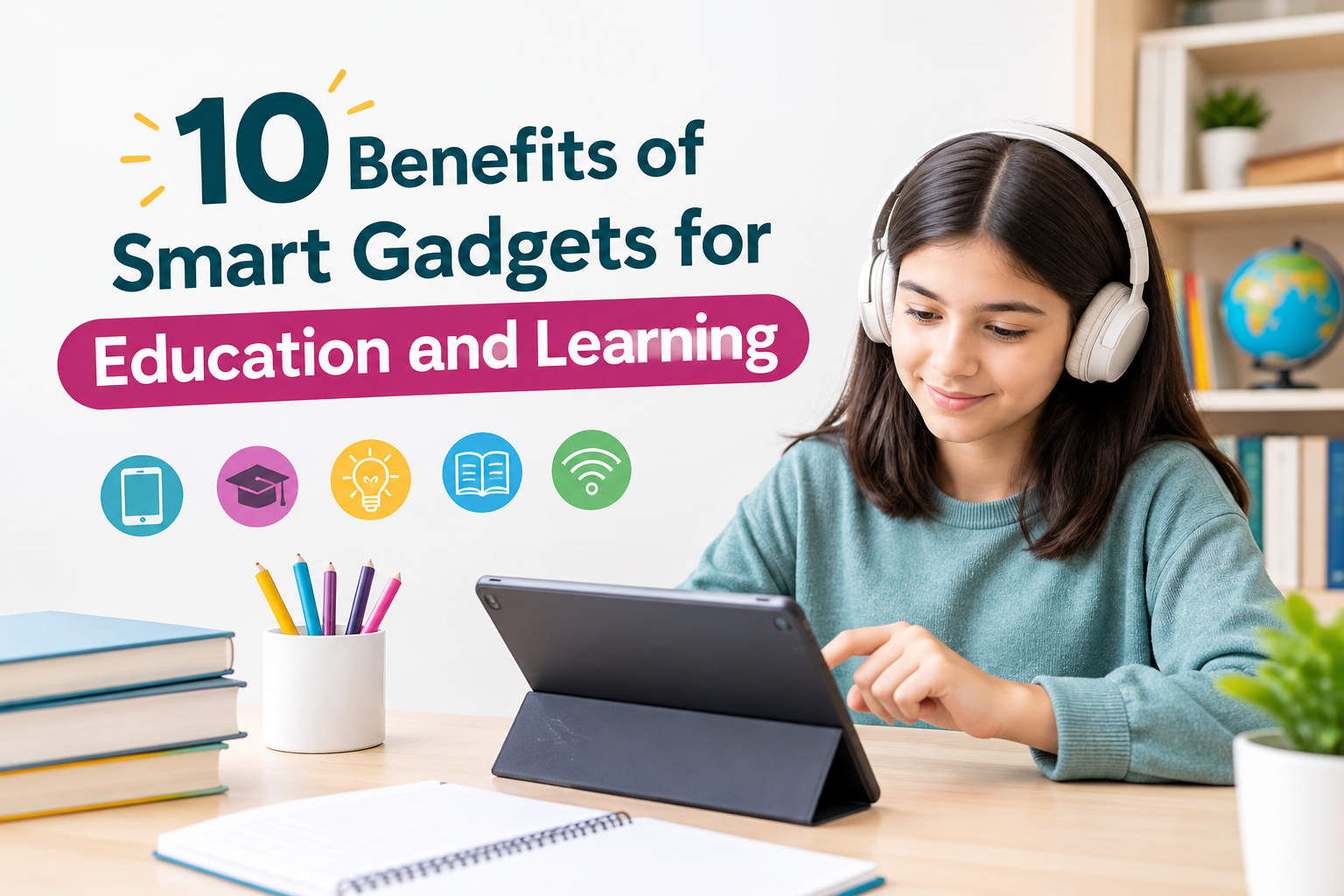

Ten years back, a classroom was pretty much chalkboards, tons of textbooks, maybe an old projector if the school was lucky. Now, walking into one is a different scene. Kids are on tablets, teachers use smart gadgets for education, and homework often goes through an app. That’s basically what folks mean by “gadgets education” – using smart tools in and out of class to help students learn quicker and better
Some users even spell it “gedgets education” when they look it up, but it’s the same idea. Technology is just part of teaching and learning now. And it’s not just to look up-to-date. Smart gadgets in education actually shift things for students, teachers, and parents. We’ll cover ten good things about bringing smart devices into school, plus a few tricky bits to watch out for. For example, a teacher might pull up a 3D model of a cell on the smart board instead of just drawing it. Or a student might use a language app to practice with a native speaker. It’s changing how we do things, for real.
Why Smart Technology in Education Matters Right Now
In the process of each generation of students growing up, the learning tools available to them have always been different. For students who attended school two or three decades ago, the things they saved their pocket money to buy were repeaters and Walkmans, which they used to assist with foreign language learning and store recordings of blackboard notes taken during classes; for students from even earlier periods, the only commonly used tools they had at hand were fountain pens and notebooks, and even printing study materials was a rare occurrence. In the era that each group of students grew up in, mainstream tools changed alongside technological development, and no single set of tools has ever been able to remain in constant use, unchanged forever.
This shift matters because it’s more than just convenience. Used right, technology in schools can close learning gaps, keep kids interested, and give teachers ways to reach different learners. Here are ten benefits of smart gadgets for education showing why schools, parents, and students are all on board with this move.
10 Benefits of Smart Gadgets for Education and Learning
1. Learning Becomes More Interactive
Sitting through a lecture where someone just talks at you for an hour is tough, even for adults. Smart gadgets for education turn passive listening into active participation. A tablet with an interactive app lets a student tap, drag, and explore a topic instead of just reading about it. Smart boards let teachers pull up videos, diagrams, and quizzes in seconds, keeping the whole class involved rather than watching one person write on a board.
2. Lessons Can Be Personalized for Each Student
No two students learn at the same pace, and that’s one of the biggest problems with traditional classrooms. Educational gadgets for students, especially apps powered by adaptive learning software, can adjust the difficulty of questions based on how a student is doing. If someone is struggling with fractions, the app slows down and offers extra practice. If they’re breezing through, it moves them ahead. This kind of personalization used to require one-on-one tutoring – now it happens automatically.
3. Information Is Available Instantly
Remember waiting for library hours or flipping through an index to find one fact? Smart devices for learning have basically erased that wait. A student with a question about a historical event, a science concept, or a math formula can find a clear explanation within seconds. This doesn’t replace deep research skills, but it does mean curiosity doesn’t have to wait until the next class or the next library visit.
4. Different Learning Styles Get Better Support
Some students learn best by reading, others by watching, and others by doing. This is one of the most underrated benefits of technology in education. A gadget can present the same lesson as a video, an interactive diagram, an audio recording, or a hands-on simulation. A student who struggles with a textbook explanation of the water cycle might finally understand it after watching a short animated video or exploring it through an app. Teachers who rely only on one teaching method often lose part of the class without meaning to, and smart devices for learning make it much easier to reach everyone at once instead of picking one style and hoping it works for the whole room when students need extra support to do my assignment.
5. Less Paperwork, More Time for Actual Learning
Printing worksheets, grading by hand, and passing around stacks of paper takes up a surprising amount of classroom time. Digital learning tools cut a lot of that out. Assignments get submitted online, grading tools flag common mistakes automatically, and lesson materials live in one shared folder instead of getting lost in a backpack. Teachers get more time to actually teach, and students spend less time waiting around.
6. Students Build Real Digital Skills Early
Whether we like it or not, almost every job today requires some level of comfort with technology. When schools use educational technology as part of daily learning, students naturally pick up skills like typing, organizing digital files, researching online safely, and using basic software — skills they’ll need long after graduation. It’s a side benefit that ends up mattering just as much as the lesson itself. A student who’s comfortable navigating apps, cloud folders, and online tools by age twelve will have a much easier time in college and in an entry-level job than one who’s seeing these tools for the first time as an adult.
7. Group Work and Collaboration Get Easier
Group projects used to mean trying to find a time everyone could meet in person. Smart technology in education makes that far less of a hassle. Students can work on a shared document at the same time from different locations, leave comments for each other, and track changes without a single printed page. This mirrors how most modern workplaces already operate, which is a nice bonus for students heading into their careers.
8. Learning Becomes More Inclusive
This is one of the most meaningful benefits of smart devices in education. Text-to-speech tools help students with dyslexia. Closed captions help students who are deaf or hard of hearing. Adjustable font sizes and screen readers help students with visual impairments. Smart gadgets for students with different needs aren’t a luxury anymore — for many, they’re the difference between struggling silently and actually keeping up with the class.
9. Staying Organized Is Simpler
Between assignments, deadlines, exams, and extracurriculars, staying on top of everything is genuinely hard for students. Apps and smart calendars send reminders, track due dates, and keep everything in one place instead of scattered across notebooks and sticky notes. For students juggling multiple classes, this kind of organization can quietly reduce a lot of unnecessary stress.
10. Students Are Better Prepared for the Future
The workplace students are heading into runs on technology, from remote meetings to cloud-based tools to AI-assisted work. Growing up with educational gadgets for students gives them a head start. They’re not learning how to use a laptop or collaborate online for the first time on their first job – they’ve already been doing it for years. This is arguably the longest-lasting benefit of technology in education, even if it’s not always the most obvious one day to day.
A Few Honest Challenges to Keep in Mind
That doesn’t imply that gadgets education is without flaws. Since these devices have a cost, not all families or schools will be able to afford the most up-to-date tablets or laptops. Screen time should be balanced with practical learning, reading, and periods when students are completely away from screens. Teachers require adequate training, or the equipment will end up being unused. And as the number of devices increases so does the amount of student data, which means that schools must take privacy seriously when it comes to how that information is stored and shared.
There is also the issue of balance. Giving a student a tablet does not automatically mean that they will become better learners, any more than giving an adult a laptop automatically makes them more productive. Schools which achieve the best results tend to establish clear rules about when devices are to be used, combine screen-based lessons with offline discussions and paper-based exercises, and regularly check to ensure that the technology is in fact helping rather than simply acting as a distraction. Parents have a role to play as well by monitoring how much time a student spends on screens doing schoolwork compared to all the other activities.
Final Thoughts
Smart gadgets in the field of education are not simply about making classrooms more impressive for the sake of it. When used properly, they make learning more personal, more accessible, and more closely linked to the real world that students will encounter after they graduate. Whether it’s through personalized lessons, improved organization, or the development of real digital skills, the advantages of technology in education extend well beyond mere convenience. The schools and students who are benefiting the most from this change are those who view the gadgets as a means of supporting learning, not as a substitute for capable teachers and true curiosity.
